Accurate Consulting · Product Designer · 2024
Self-assessment survey platform designed as an entry-point product for a management consultancy.
Accurate Consulting is a management consultancy. One of the ways they work with client organisations is through deep qualitative interviews with employees. To offer a lower-cost entry point alongside that kind of engagement, they wanted a self-assessment survey tool — something managers at client companies could complete themselves, generating quantitative data that Accurate could fold into their reports. The brief was to design that product from scratch as an MVP.
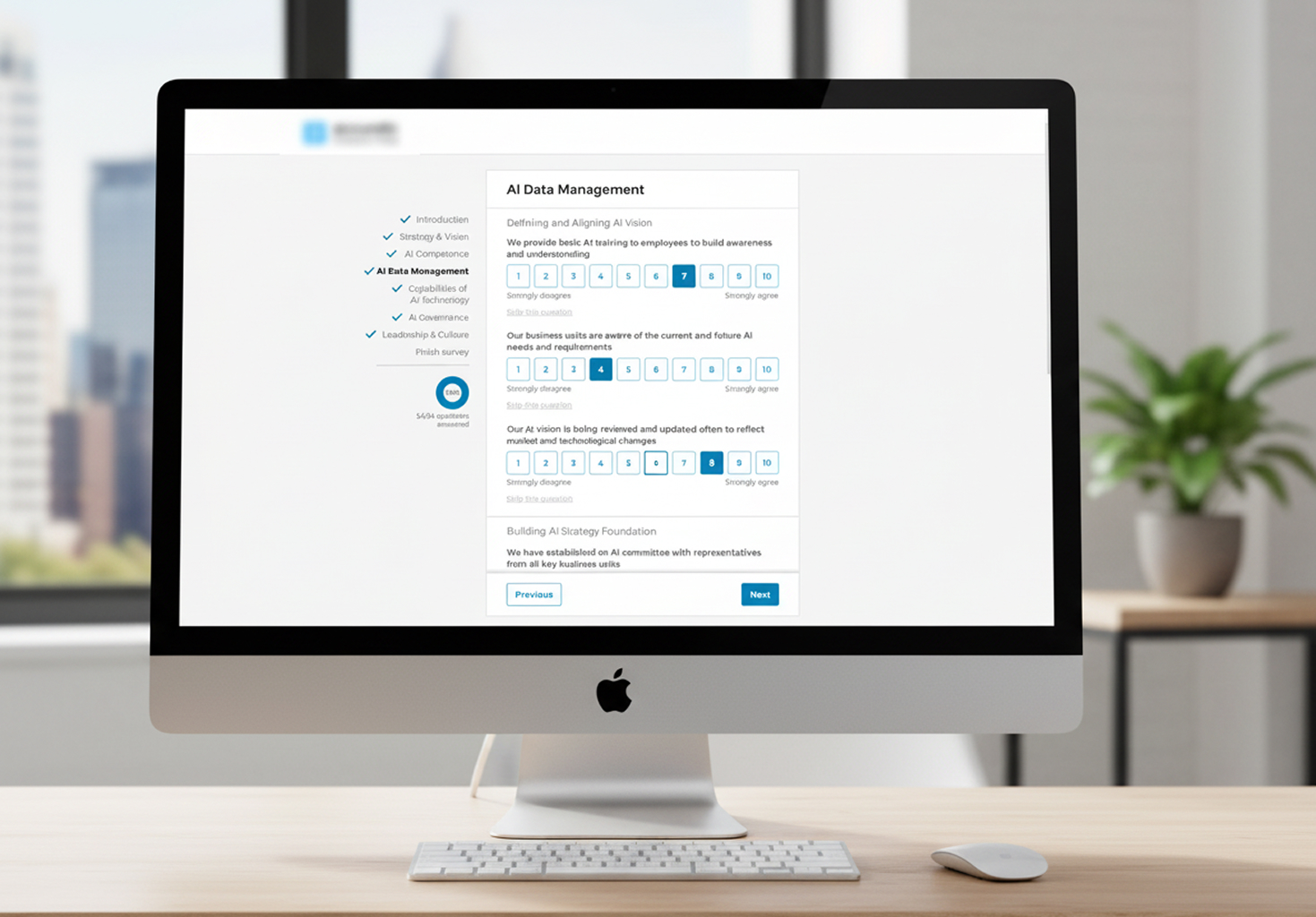
The core design challenge was survey UX. The surveys were long and complex, spanning many questions that required careful thought from the managers filling them in. A survey someone abandons halfway through is worth nothing — to Accurate, to their client, or to the report the data was meant to inform. The product had to carry people through that complexity without losing them.
I led the product design end-to-end: scoping the MVP, designing the survey flow and interface, and partnering with the small development team building it.
The entry-product framing shaped where the constraints landed. To keep cost down, the MVP was deliberately lean on the development side — no admin tooling, no user management UI; survey assignments were handled directly in the database. On the design side the trade went the other way: UX was treated as non-negotiable. The product’s value depended entirely on whether managers actually completed the surveys.
Most of the design work was about reducing friction in the survey experience itself. Long surveys create natural drop-off points, and the visual and interaction design had to work against that — clear progress, low cognitive load per question, a structure that made the end feel reachable from the start.
The tool is live and has been used in several client engagements. This was a lean, speculative MVP, so we don’t yet have deep data on how managers experience it at scale — but the work is in production and the core hypothesis is being tested.
Small team, fast tempo. I worked in short, structured handoffs — a Figma frame, a note on the intent behind it, and the open questions named explicitly so we could close them in conversation rather than email chains. When something was ambiguous I’d rather surface it directly than design around it. That cadence held up well here and is one I default to on small-team work.